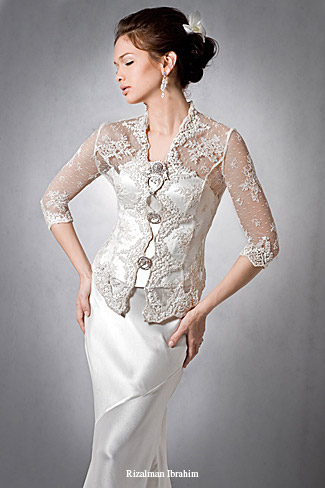
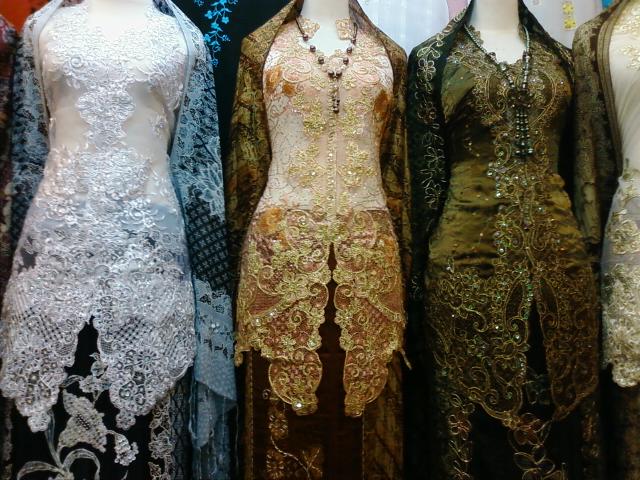
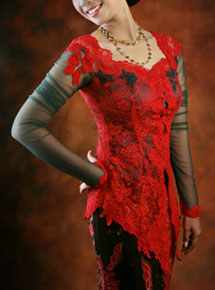
Kebaya Nyonya (Innovation of Tradisional Kebaya)
  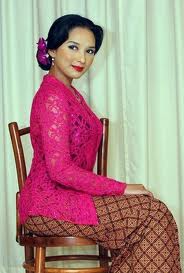 | IntroductionMalaysia is a multicultural society with a rich cultural heritage. It has a total population more than 21 million consisting of the Malays, Chinese, Indians, Kadazans, Dayaks, Bajaus, Melanaus, Muruts, Eurasians and the aborigines (Shahar, 2000). Malaysia’s uniquely diverse cultural heritage stems from these ethnic communities and the immigrant population like the Chinese and Indians. One example of which Malaysia’s immigrant populations have contributed to the nation’s culture as a whole is in the history of Chinese immigrants (Geographia; 2005). The first Chinese to settle in the country, primarily in and around Malacca, gradually adopted elements of Malay culture and intermarried with the Malay community. Straits Chinese, Straits Born Chinese, Baba Chinese, Baba (and their womenfolk Nyonya) and Peranakan are terms used interchangeably in Malaysia to describe the Baba Nyonya community, a subethnic group of the Peranakan Chinese community. The Baba Nyonya community has since firmly established themselves in Malacca, Penang and in the island state of Singapore (Mahmood, 2004). Their culture consists of a set of practices, beliefs, and arts, combining Malay and Chinese traditions.Unfortunately the esthetic of the Peranakan culture which is perceived as beautiful is dying slowly because of modernization and of inter-marriages (Cheah, 2005). Datin Seri Endon Mahmood has also been accredited with the revival of the culture as well as the revival of the dress for the female Peranakan, the Nyonya Kebaya (www.kakiseni.com.my). Thus a series of exhibitions were planned and organized in the museums and cultural centers in Malaysia. One of the main aims of this exhibition is to inspire the Malaysian public to help conserve and keep alive the Nyonya Kebaya which has been used by the female Peranakan for over a century (Mahmood, 2004).In Malaysia several issues arise in conserving cultural heritage information. The issues are:i. Lack of standards on the description and graphic presentations of cultural products.ii. Large portions of invaluable cultural heritage are fast deteriorating due to poor maintenance and preservation practices.iii. Large portion of cultural heritage are in oral traditions, some are regarded as sacred.iv. Most cultural products are located in different institutions and most often they are not properly documented.v. Large portion of cultural heritage products are in private or individual hands and very little is known about it.There is a need for training on documentation of cultural heritage information sources and database creation and on cultural information resources complete with graphic presentation of cultural images (Sahar,2000). The availability of cultural databases that are accessible through the Internet is lacking in Malaysia (Sahar,2000). Therefore here the researchers have collected data on the Nyonya Kebaya from various sources and than systematically documented the data, created a data model which is then implemented using a RDBMS. This cultural heritage information can then be easily accessed by anyone through the Internet. This will ensure accurate, timely and integrated cultural information on the Nyonya Kebaya thus helping to preserve its esthetic beauty. |
Our Shop
Our shop is a treasure box full of fashion inspiration, accessory ideas, and knowledgeable staff ready to assist you. Whether you're looking for a complete makeover or for that elusive piece to complete your outfit, we can help!
Customer Reviews
"This is sample review from a sample source." -- Sample Client, Location
"This is another sample review from another sample source." -- Sample Client, Location
kebayanyonya.com kebayanyonya1.com, Petaling Jaya,Selangor | 01234567890 |